Read page 1 as text
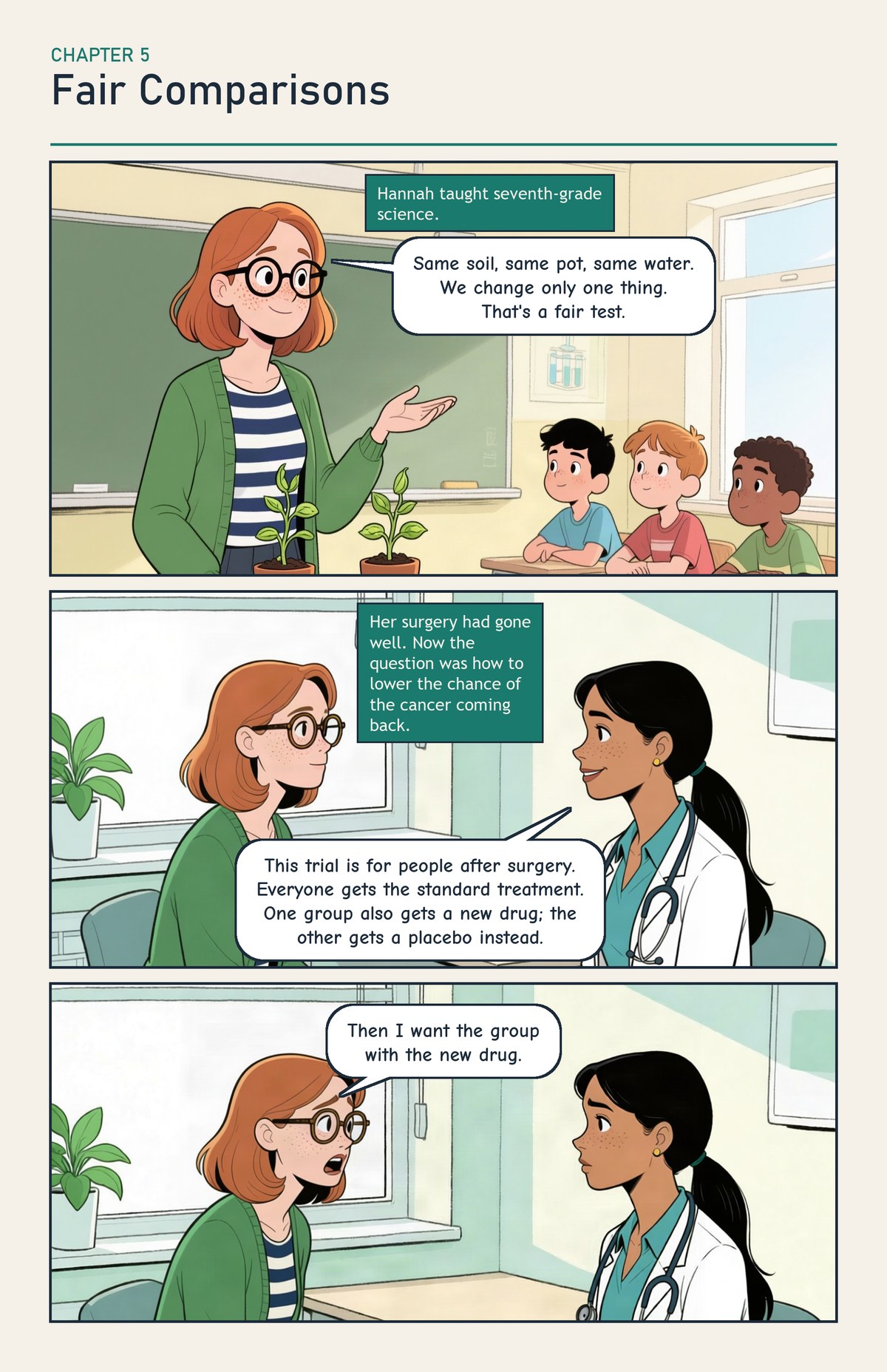
Hannah taught seventh-grade science.
Hannah: Same soil, same pot, same water. We change only one thing. That's a fair test.
Her surgery had gone well. Now the question was how to lower the chance of the cancer coming back.
Dr. Nair: This trial is for people after surgery. Everyone gets the standard treatment. One group also gets a new drug; the other gets a placebo instead.
Hannah: Then I want the group with the new drug.
Read page 2 as text
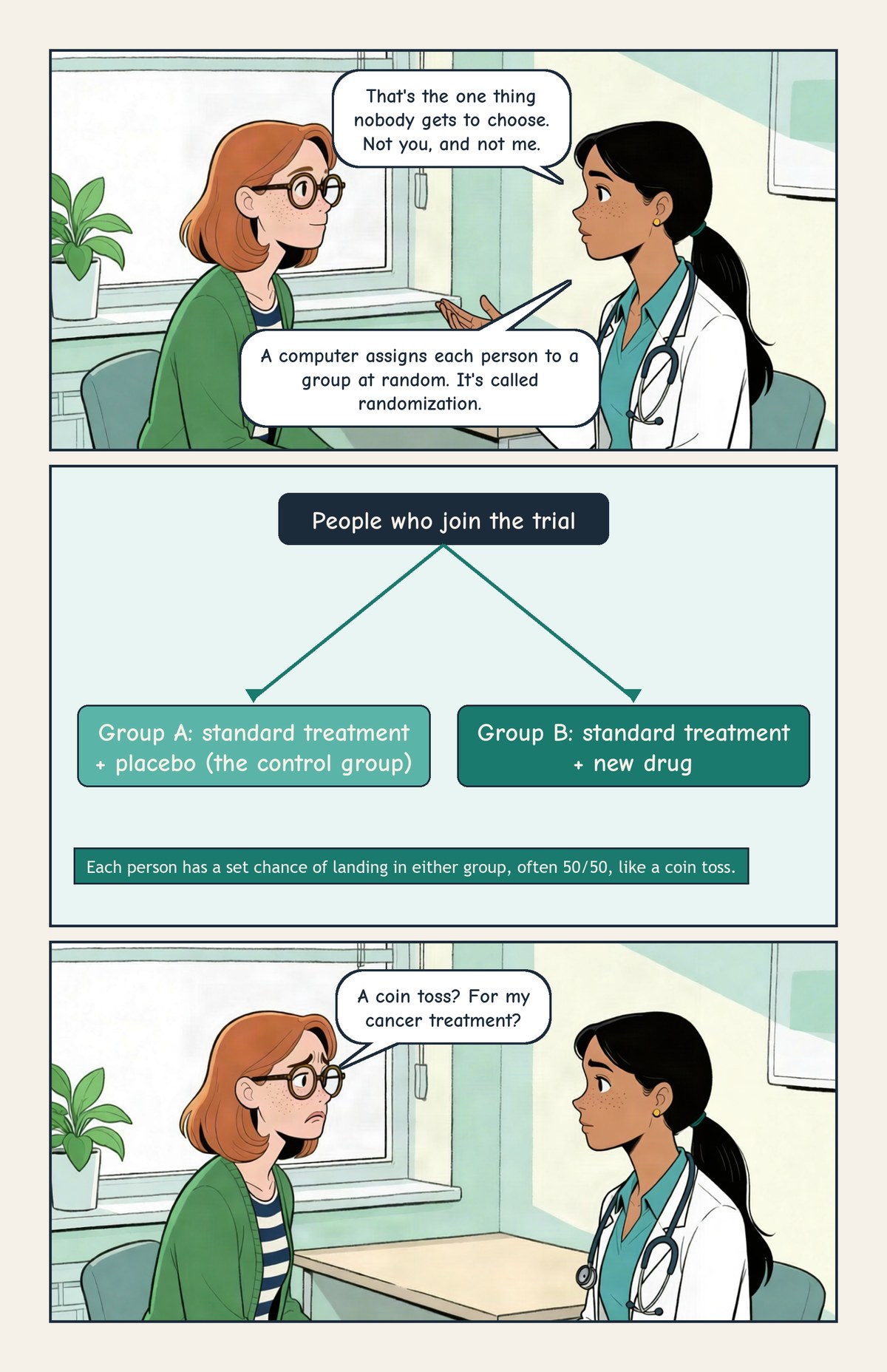
Dr. Nair: That's the one thing nobody gets to choose. Not you, and not me.
Dr. Nair: A computer assigns each person to a group at random. It's called randomization.
Diagram: People who join the trial → Group A: standard treatment + placebo (the control group) / Group B: standard treatment + new drug
Each person has a set chance of landing in either group, often 50/50, like a coin toss.
Hannah: A coin toss? For my cancer treatment?

Read page 3 as text
Dr. Nair: If doctors picked, we might give the new drug to people who were healthier to begin with. Then it would look better than it really is.
Hannah: …Because then you've changed more than one thing. It's a fair test.
Dr. Nair: Exactly. And the control group isn't left out. They get the best treatment we know today. The question is whether the new drug makes it better.
Read page 4 as text
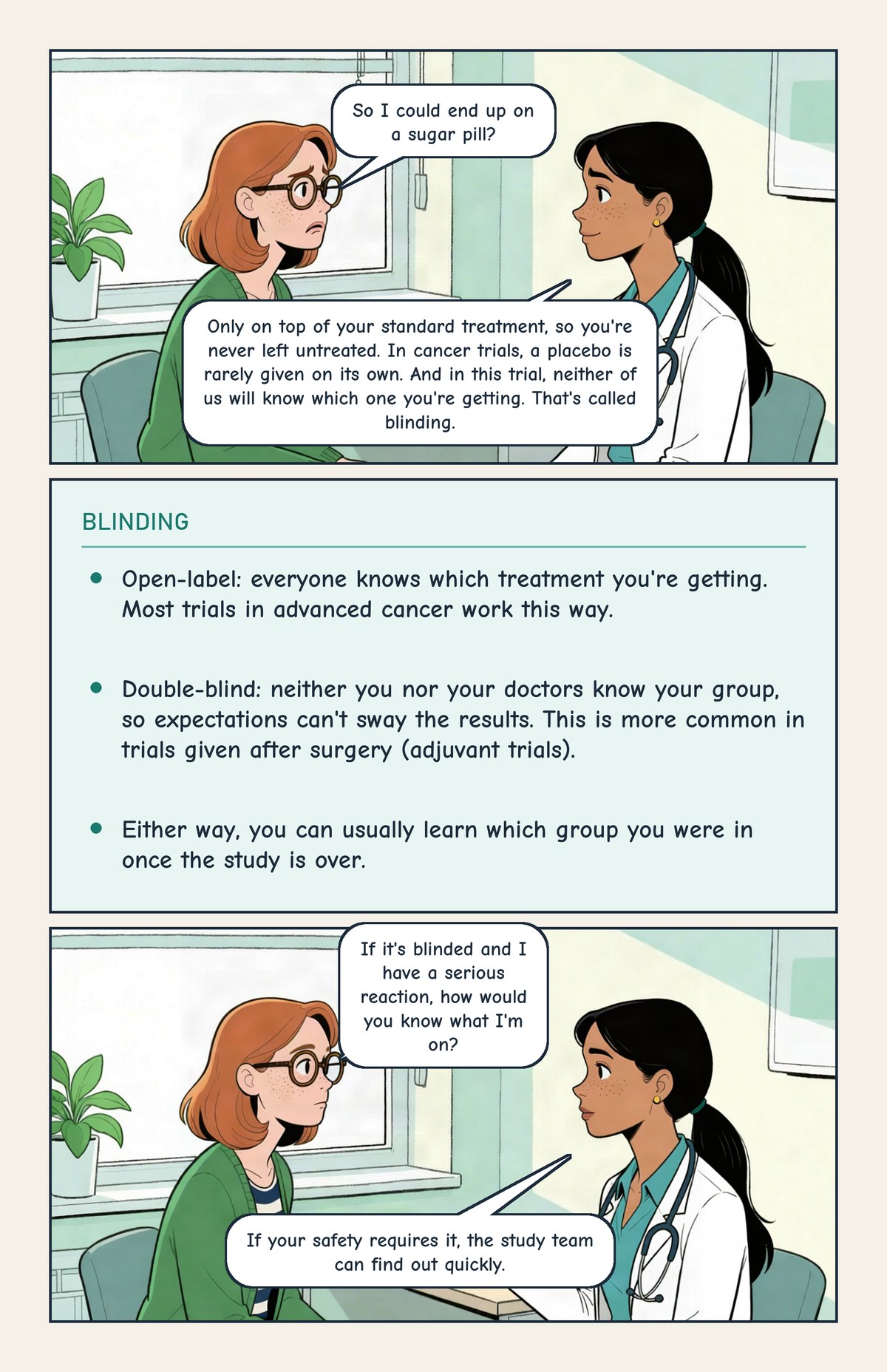
Hannah: So I could end up on a sugar pill?
Dr. Nair: Only on top of your standard treatment, so you're never left untreated. In cancer trials, a placebo is rarely given on its own. And in this trial, neither of us will know which one you're getting. That's called blinding.
Blinding
- Open-label: everyone knows which treatment you're getting. Most trials in advanced cancer work this way.
- Double-blind: neither you nor your doctors know your group, so expectations can't sway the results. This is more common in trials given after surgery (adjuvant trials).
- Either way, you can usually learn which group you were in once the study is over.
Hannah: If it's blinded and I have a serious reaction, how would you know what I'm on?
Dr. Nair: If your safety requires it, the study team can find out quickly.
Read page 5 as text
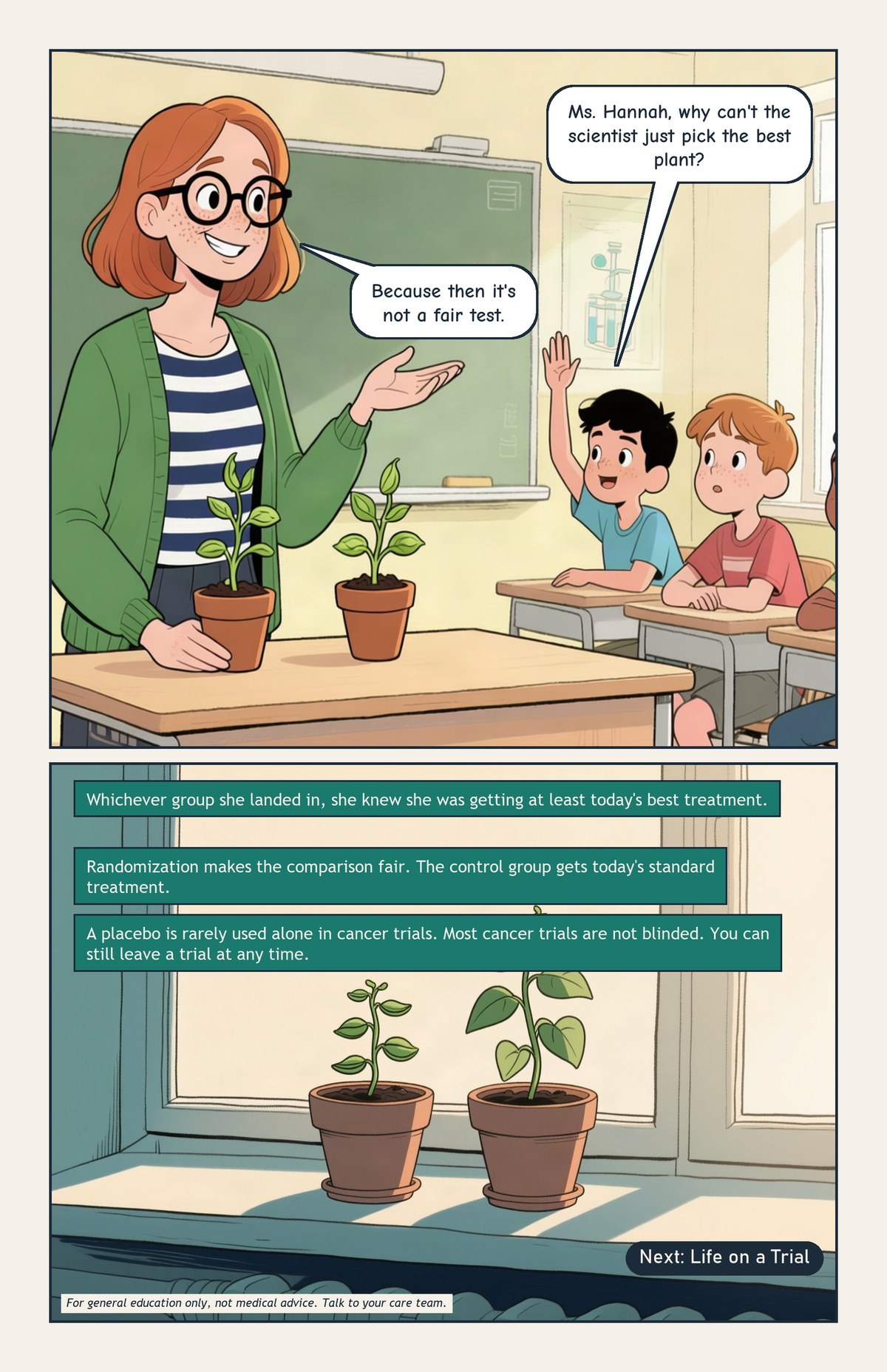
Student: Ms. Hannah, why can't the scientist just pick the best plant?
Hannah: Because then it's not a fair test.
Whichever group she landed in, she knew she was getting at least today's best treatment.
Randomization makes the comparison fair. The control group gets today's standard treatment.
A placebo is rarely used alone in cancer trials. Most cancer trials are not blinded. You can still leave a trial at any time.
For general education only, not medical advice. Talk to your care team.
The people in these guides are fictional, and any trial numbers are examples. For general education only. Talk to your care team about your own situation.