Read page 1 as text
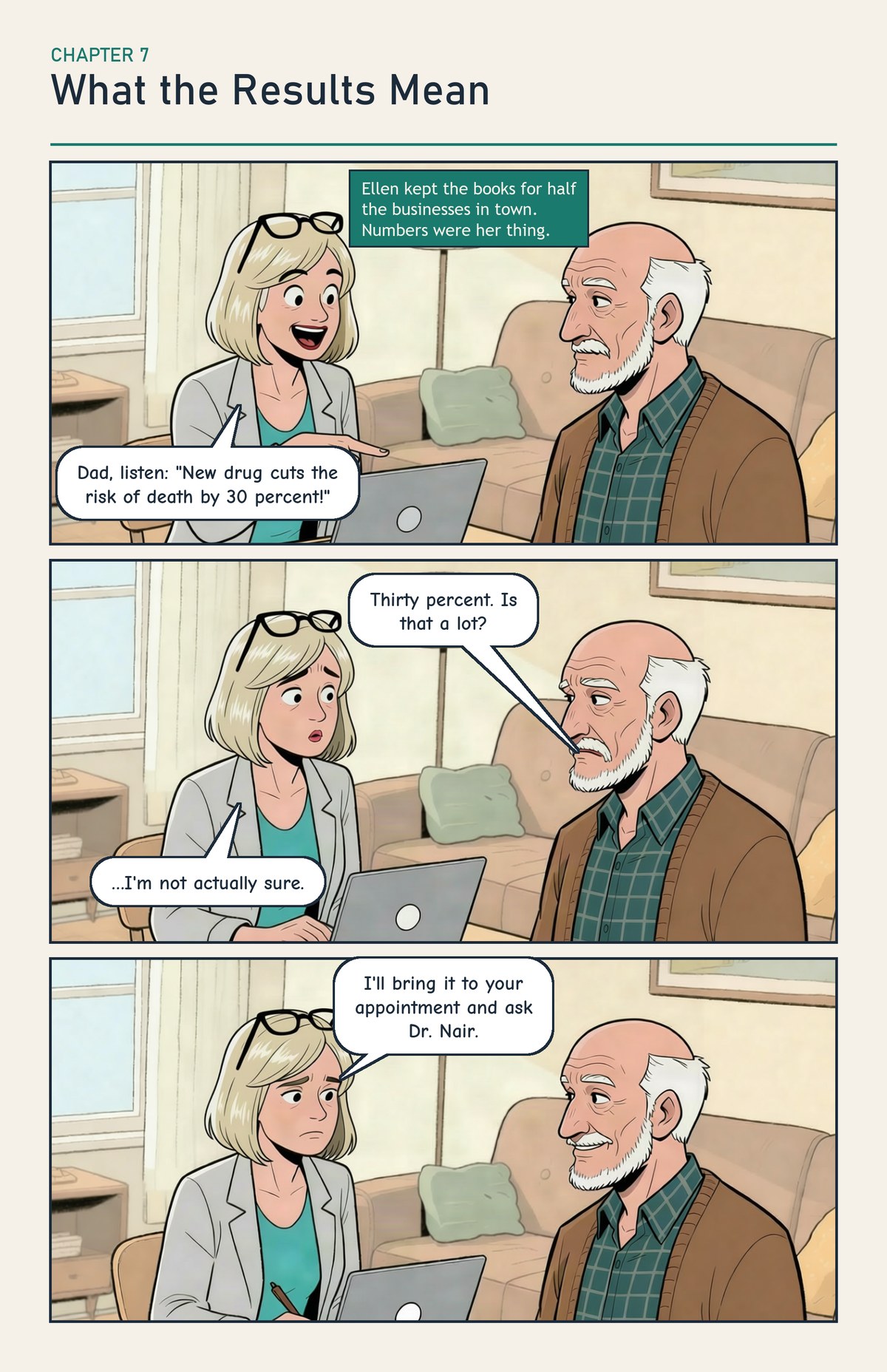
Ellen kept the books for half the businesses in town. Numbers were her thing.
Ellen: Dad, listen: "New drug cuts the risk of death by 30 percent!"
Frank: Thirty percent. Is that a lot?
Ellen: …I'm not actually sure.
Ellen: I'll bring it to your appointment and ask Dr. Nair.
Read page 2 as text
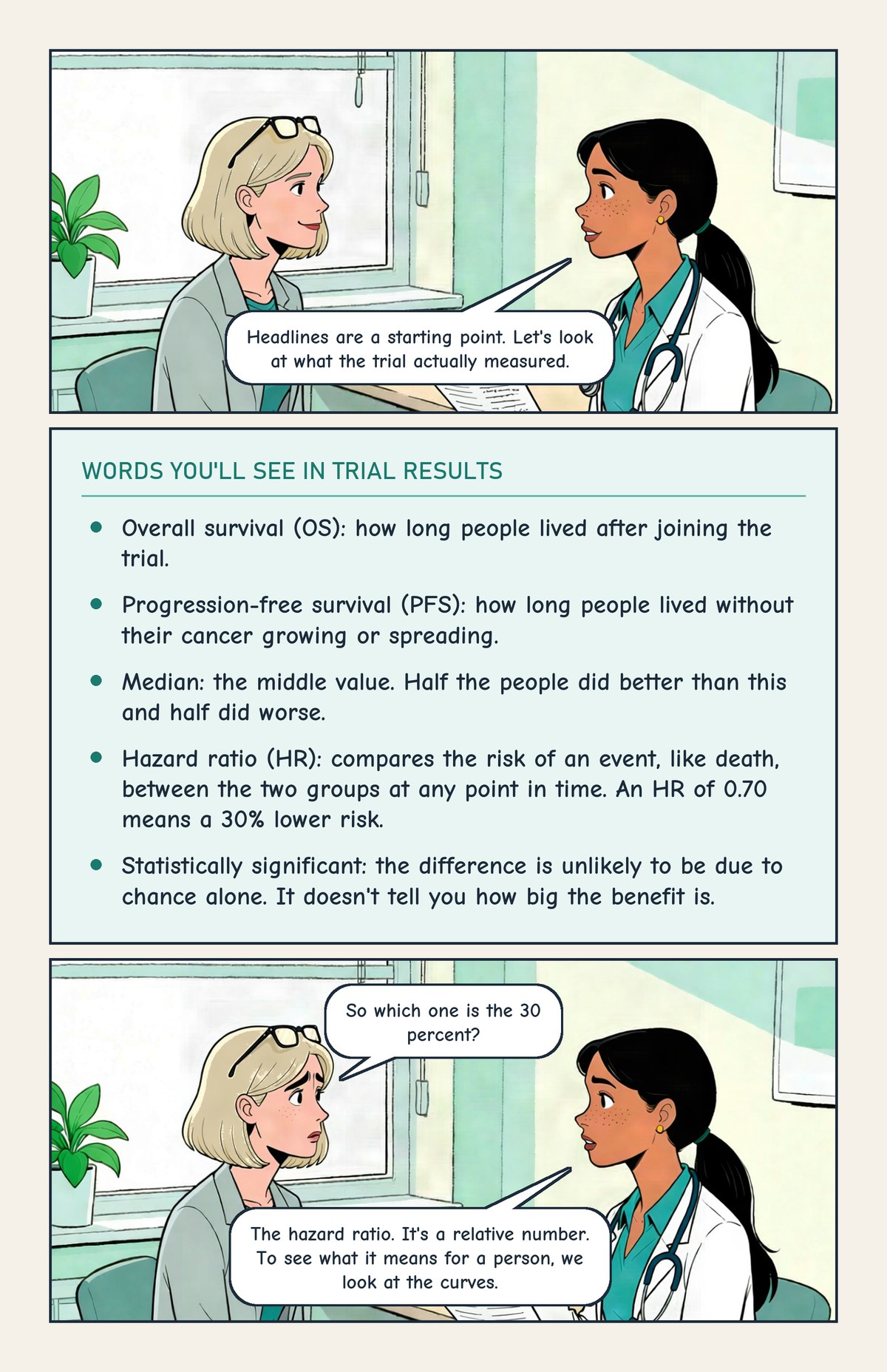
Dr. Nair: Headlines are a starting point. Let's look at what the trial actually measured.
Words you'll see in trial results
- Overall survival (OS): how long people lived after joining the trial.
- Progression-free survival (PFS): how long people lived without their cancer growing or spreading.
- Median: the middle value. Half the people did better than this and half did worse.
- Hazard ratio (HR): compares the risk of an event, like death, between the two groups at any point in time. An HR of 0.70 means a 30% lower risk.
- Statistically significant: the difference is unlikely to be due to chance alone. It doesn't tell you how big the benefit is.
Ellen: So which one is the 30 percent?
Dr. Nair: The hazard ratio. It's a relative number. To see what it means for a person, we look at the curves.
Read page 3 as text
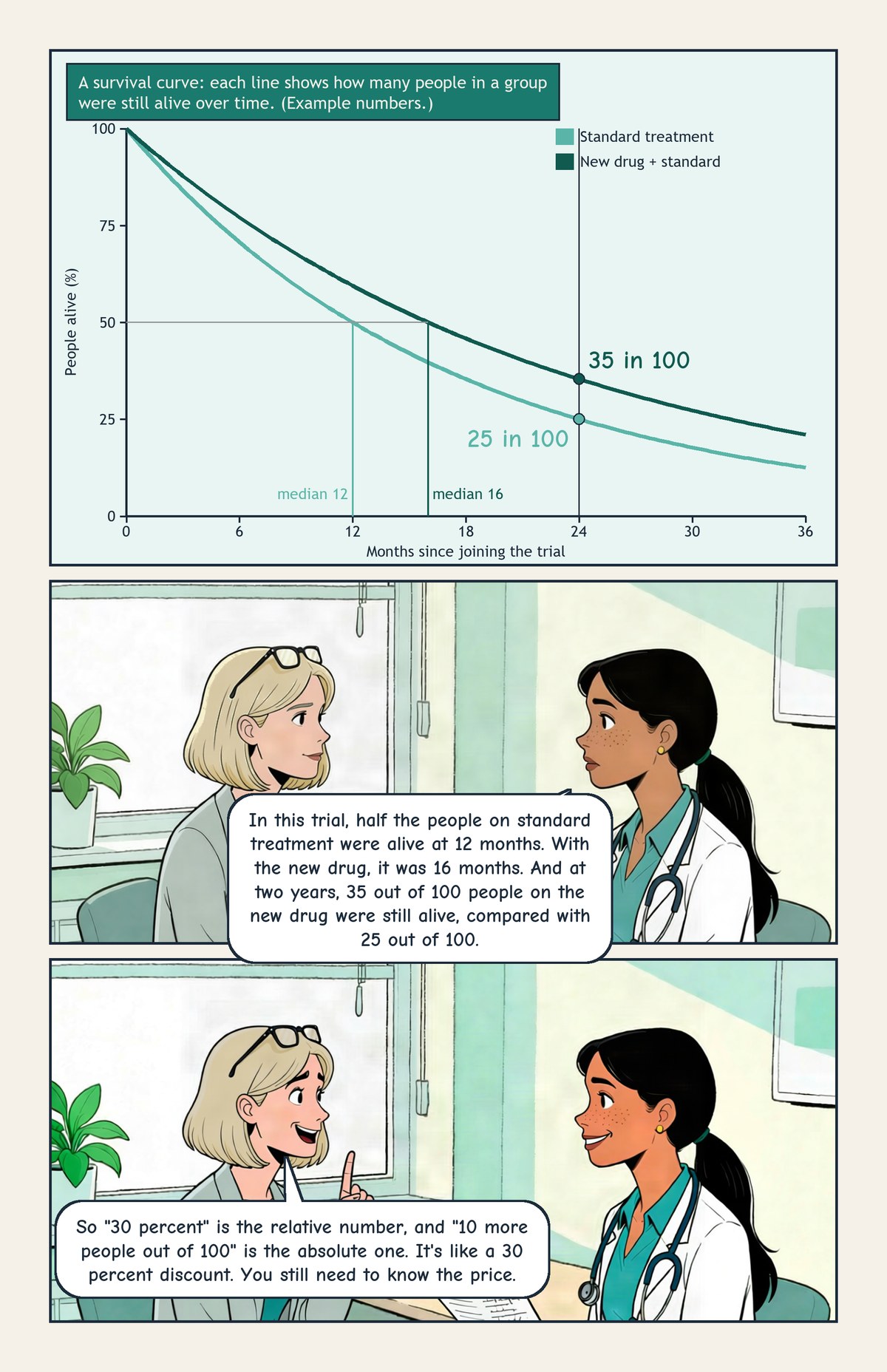
A survival curve: each line shows how many people in a group were still alive over time. (Example numbers.)
Chart (example numbers): survival curves for Standard treatment (median 12 months) and New drug + standard (median 16 months). At 24 months, 25 in 100 vs 35 in 100 were alive.
Dr. Nair: In this trial, half the people on standard treatment were alive at 12 months. With the new drug, it was 16 months. And at two years, 35 out of 100 people on the new drug were still alive, compared with 25 out of 100.
Ellen: So "30 percent" is the relative number, and "10 more people out of 100" is the absolute one. It's like a 30 percent discount. You still need to know the price.
Read page 4 as text
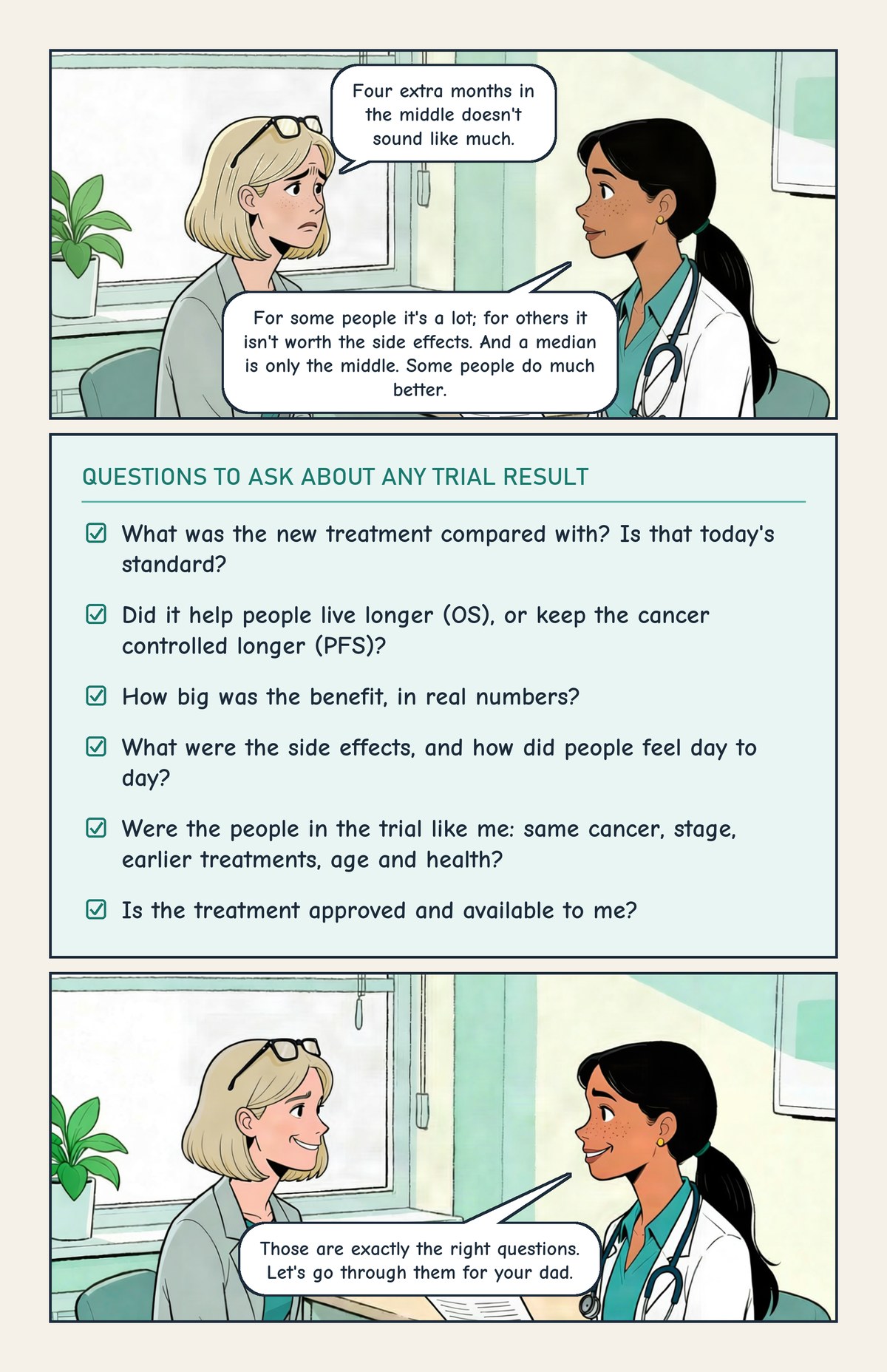
Ellen: Four extra months in the middle doesn't sound like much.
Dr. Nair: For some people it's a lot; for others it isn't worth the side effects. And a median is only the middle. Some people do much better.
Questions to ask about any trial result
- What was the new treatment compared with? Is that today's standard?
- Did it help people live longer (OS), or keep the cancer controlled longer (PFS)?
- How big was the benefit, in real numbers?
- What were the side effects, and how did people feel day to day?
- Were the people in the trial like me: same cancer, stage, earlier treatments, age and health?
- Is the treatment approved and available to me?
Dr. Nair: Those are exactly the right questions. Let's go through them for your dad.
Read page 5 as text
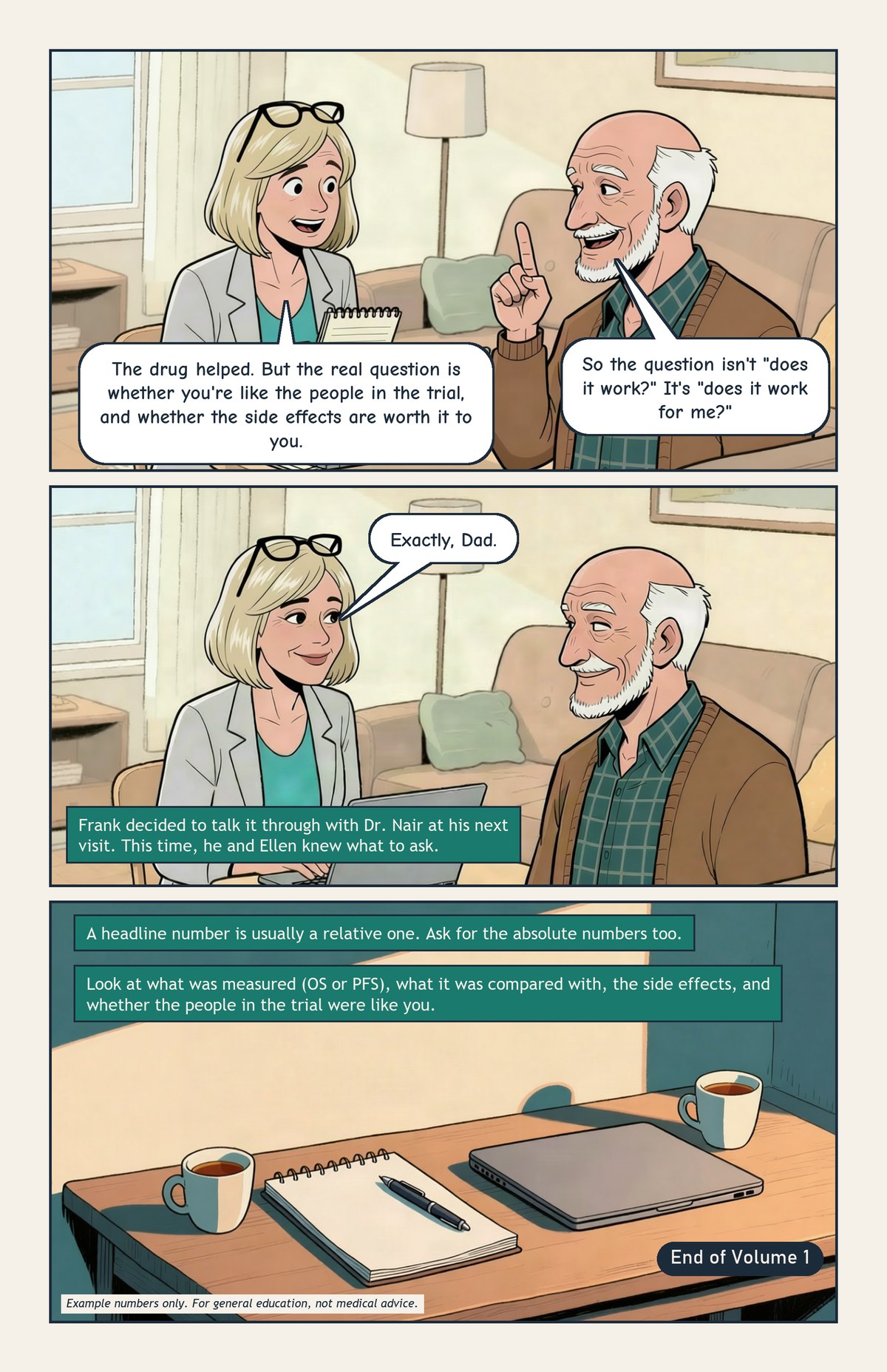
Ellen: The drug helped. But the real question is whether you're like the people in the trial, and whether the side effects are worth it to you.
Frank: So the question isn't "does it work?" It's "does it work for me?"
Ellen: Exactly, Dad.
Frank decided to talk it through with Dr. Nair at his next visit. This time, he and Ellen knew what to ask.
A headline number is usually a relative one. Ask for the absolute numbers too.
Look at what was measured (OS or PFS), what it was compared with, the side effects, and whether the people in the trial were like you.
Example numbers only. For general education, not medical advice.
The people in these guides are fictional, and any trial numbers are examples. For general education only. Talk to your care team about your own situation.