
Read page 1 as text
Grace had just learned about her treatment options.
Dr. Nair: There's the standard treatment. And there's also a clinical trial you may be able to join.
Grace: A trial? Like… an experiment? I don't want to be a guinea pig.
Dr. Nair: That's one of the most common worries I hear.
Dr. Nair: A clinical trial is a carefully planned research study with people. It asks one question: can we do better than today's best treatment?
Daniel: Better how?
Read page 2 as text
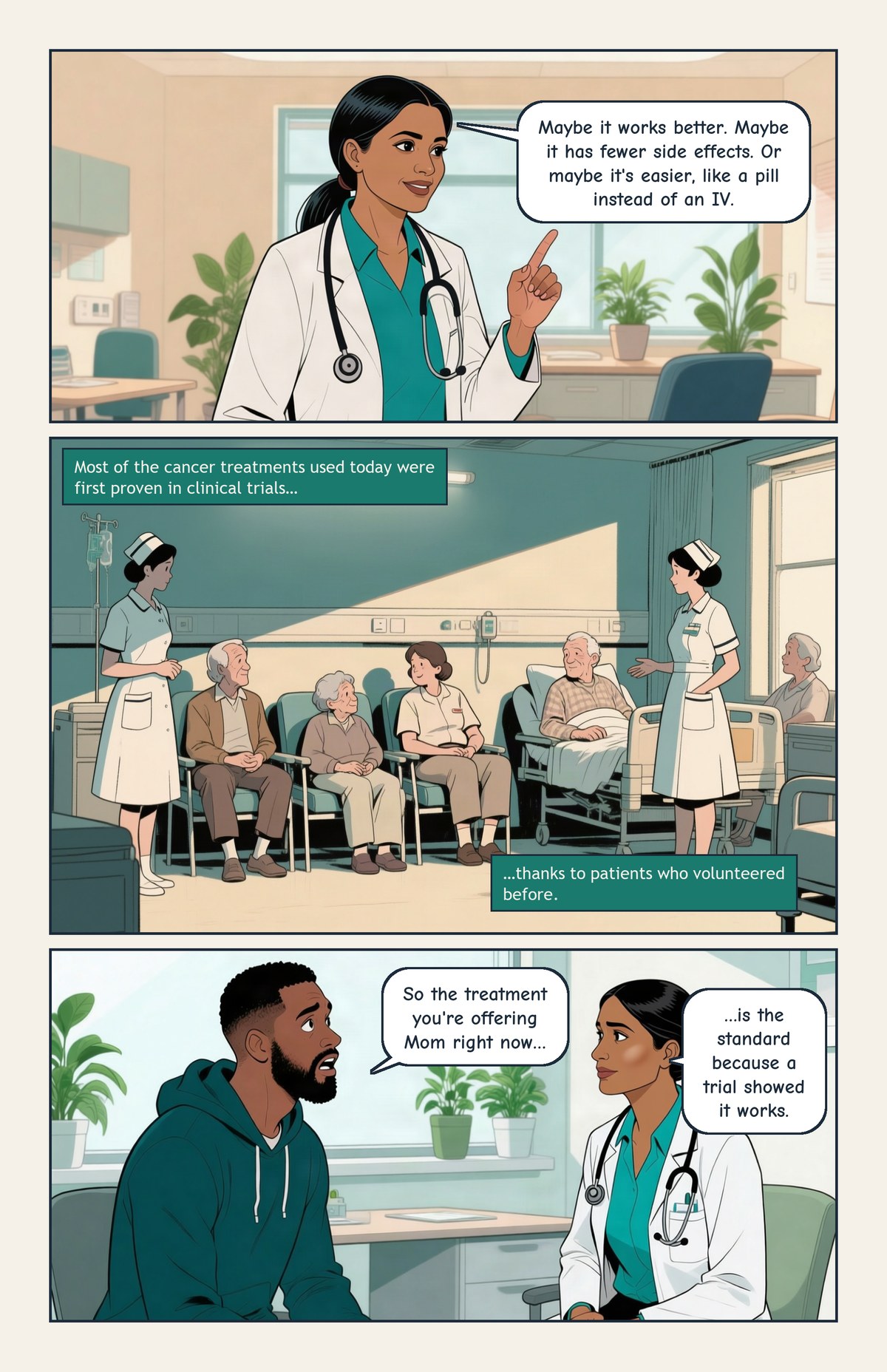
Dr. Nair: Maybe it works better. Maybe it has fewer side effects. Or maybe it's easier, like a pill instead of an IV.
Most of the cancer treatments used today were first proven in clinical trials…
…thanks to patients who volunteered before.
Daniel: So the treatment you're offering Mom right now…
Dr. Nair: …is the standard because a trial showed it works.
Read page 3 as text
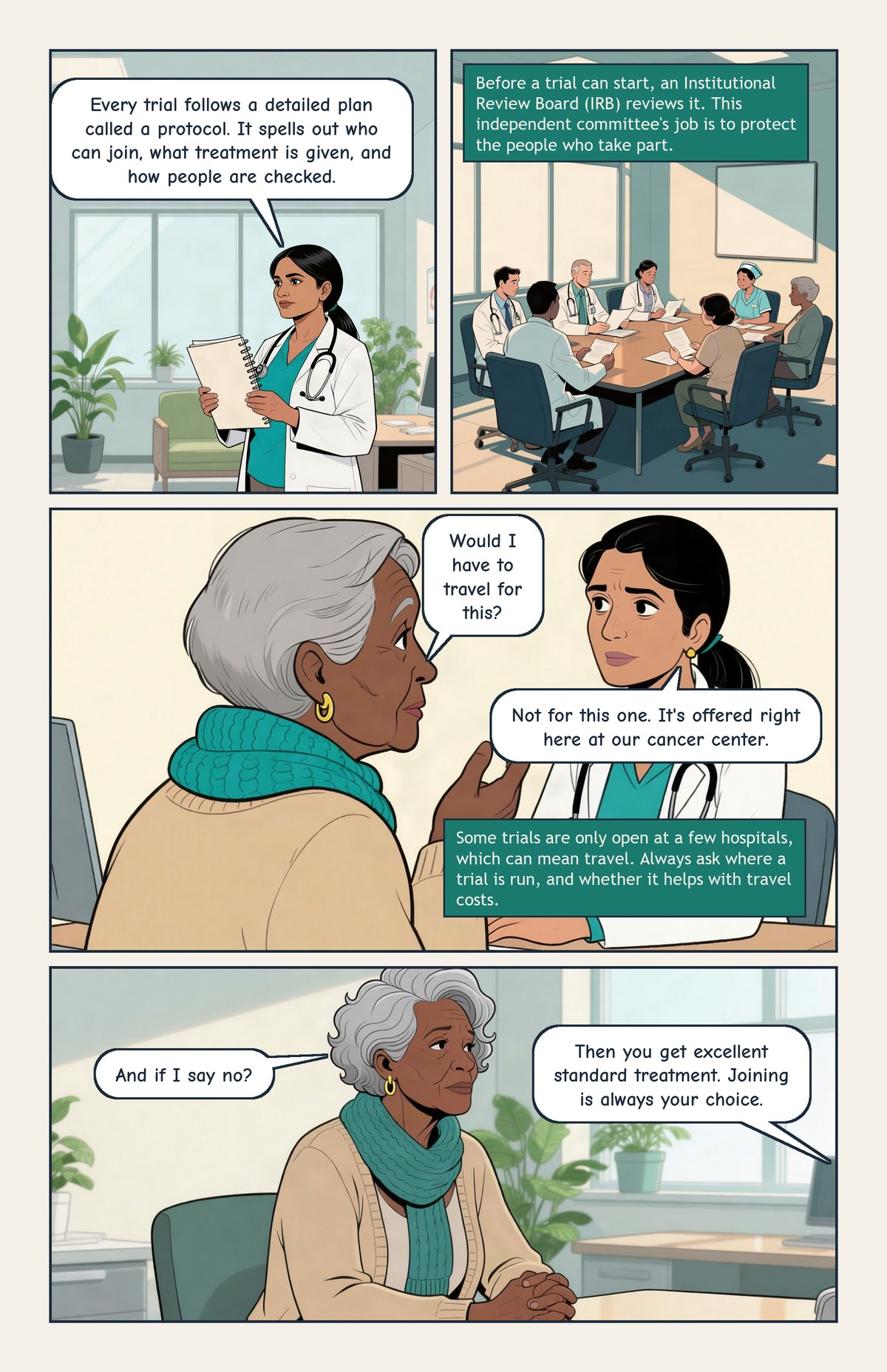
Dr. Nair: Every trial follows a detailed plan called a protocol. It spells out who can join, what treatment is given, and how people are checked.
Before a trial can start, an Institutional Review Board (IRB) reviews it. This independent committee's job is to protect the people who take part.
Grace: Would I have to travel for this?
Dr. Nair: Not for this one. It's offered right here at our cancer center.
Some trials are only open at a few hospitals, which can mean travel. Always ask where a trial is run, and whether it helps with travel costs.
Grace: And if I say no?
Dr. Nair: Then you get excellent standard treatment. Joining is always your choice.
Read page 4 as text
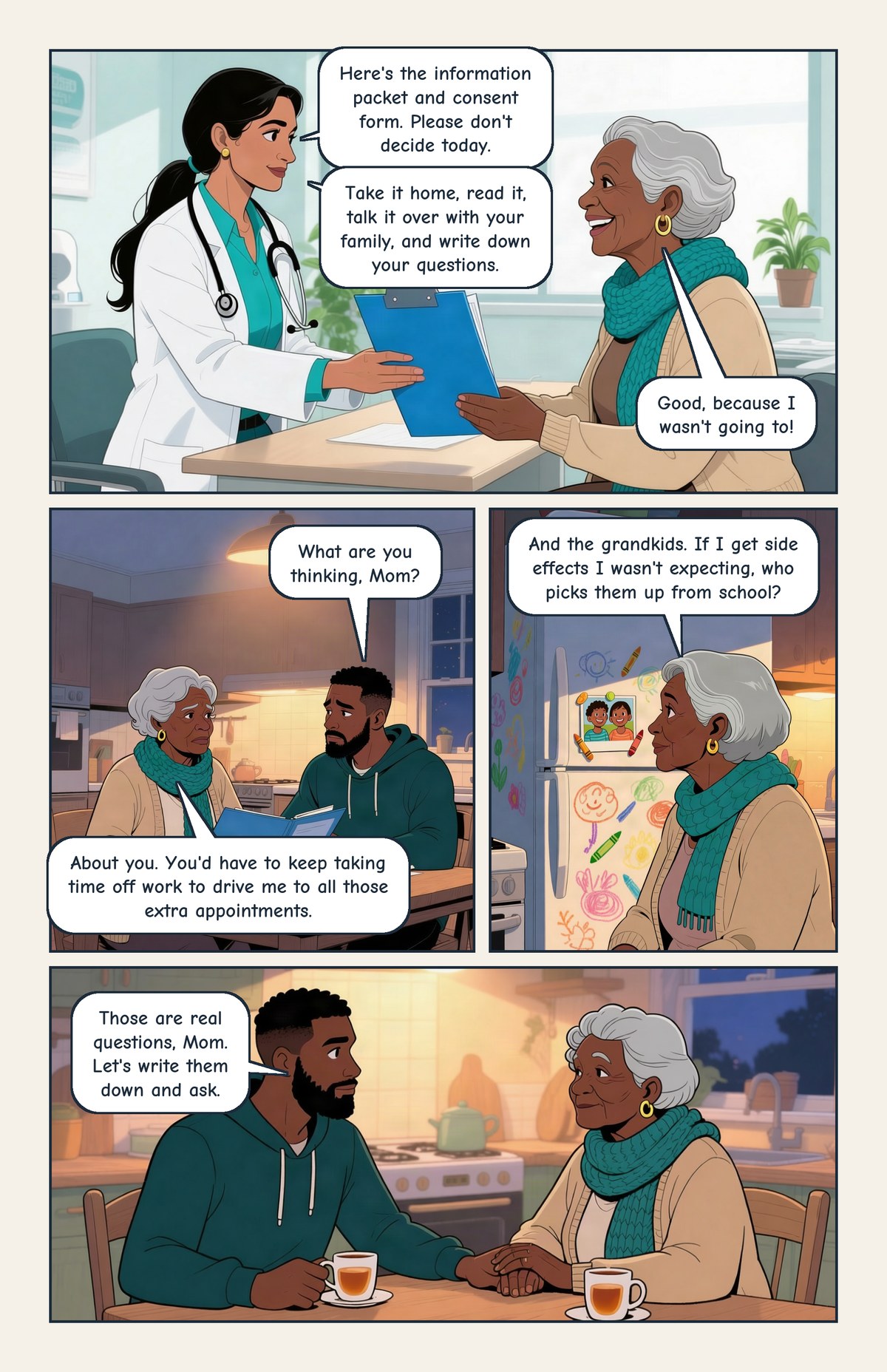
Dr. Nair: Here's the information packet and consent form. Please don't decide today.
Dr. Nair: Take it home, read it, talk it over with your family, and write down your questions.
Grace: Good, because I wasn't going to!
Grace: About you. You'd have to keep taking time off work to drive me to all those extra appointments.
Daniel: What are you thinking, Mom?
Grace: And the grandkids. If I get side effects I wasn't expecting, who picks them up from school?
Daniel: Those are real questions, Mom. Let's write them down and ask.
Read page 5 as text
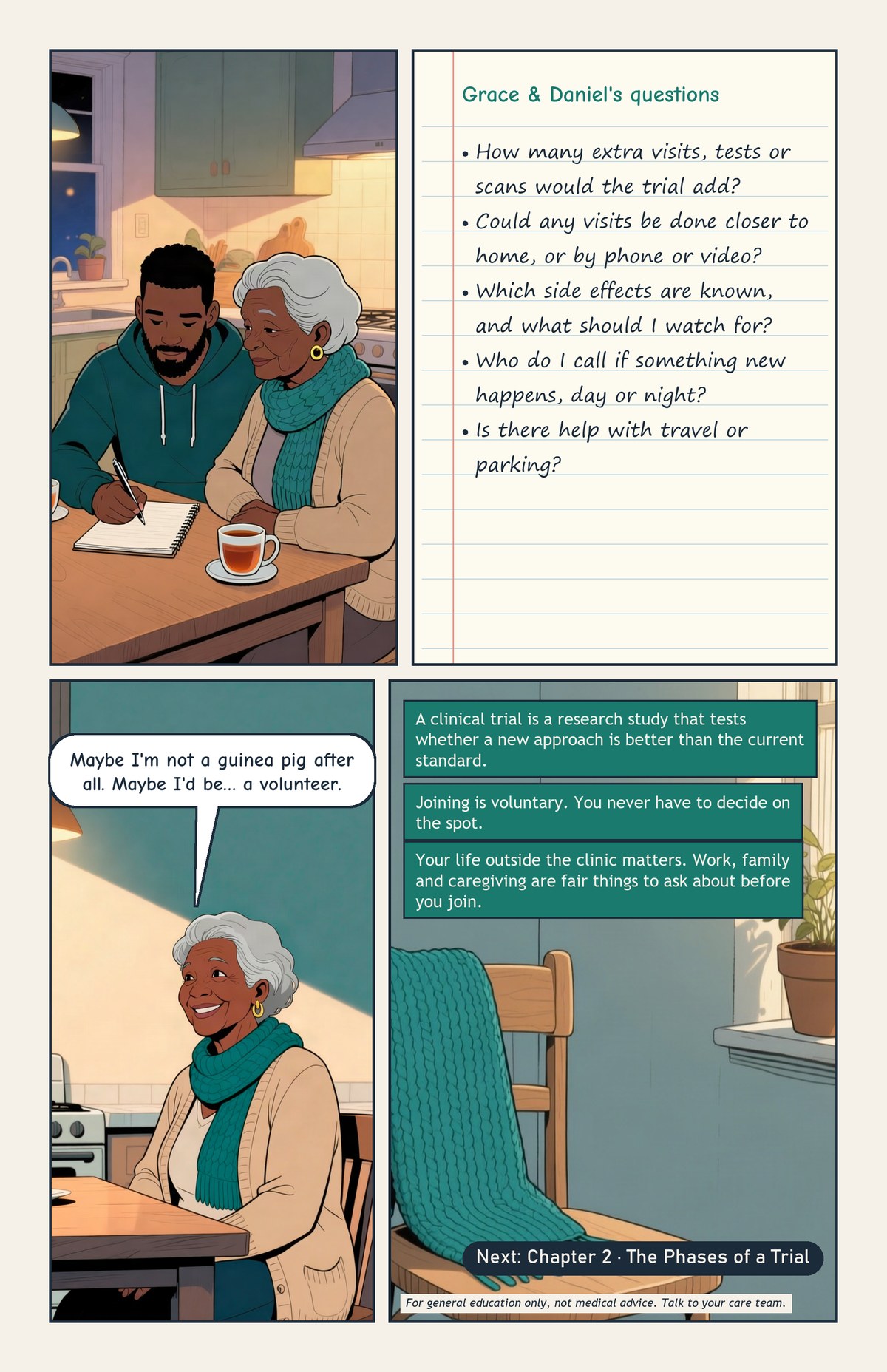
Grace & Daniel's questions
- How many extra visits, tests or scans would the trial add?
- Could any visits be done closer to home, or by phone or video?
- Which side effects are known, and what should I watch for?
- Who do I call if something new happens, day or night?
- Is there help with travel or parking?
Grace: Maybe I'm not a guinea pig after all. Maybe I'd be… a volunteer.
A clinical trial is a research study that tests whether a new approach is better than the current standard.
Joining is voluntary. You never have to decide on the spot.
Your life outside the clinic matters. Work, family and caregiving are fair things to ask about before you join.
For general education only, not medical advice. Talk to your care team.
The people in these guides are fictional, and any trial numbers are examples. For general education only. Talk to your care team about your own situation.